
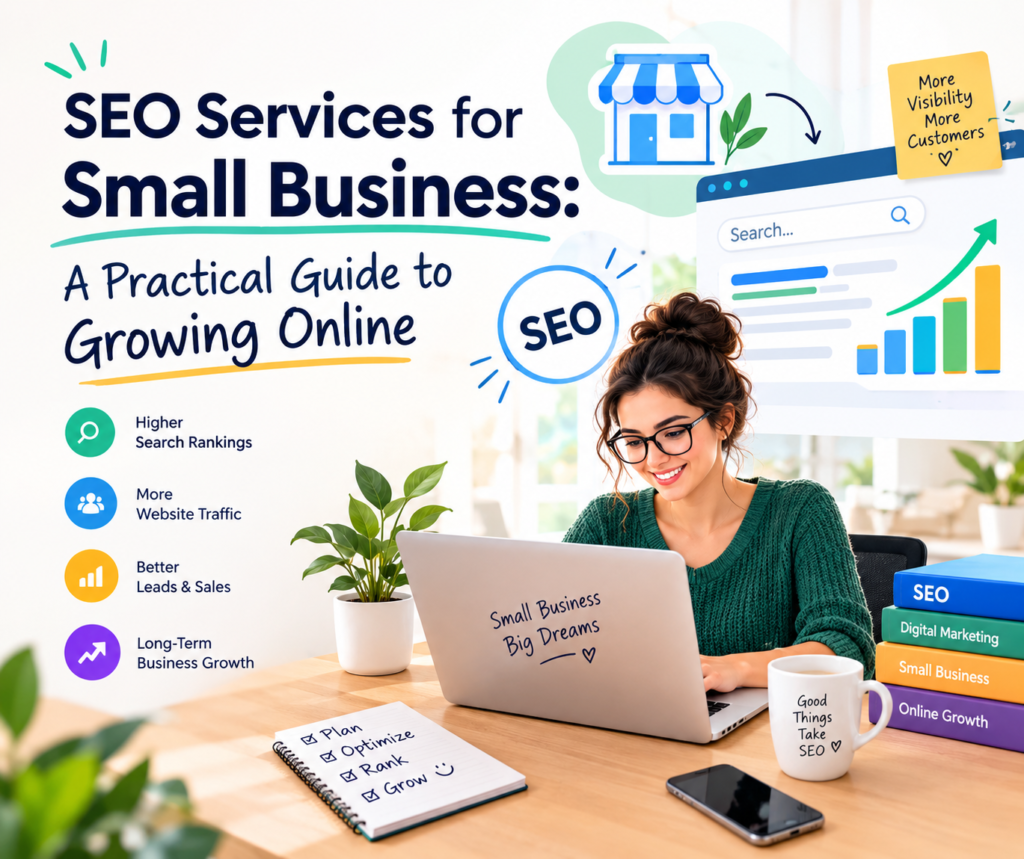
Running a small business is not easy. You have products to sell, customers to serve, employees to manage, and countless daily tasks to handle.
Getting found on Google should not become another full-time job.
This is where SEO services for small business can help. Search engine optimization can improve your website’s visibility, bring relevant visitors to your pages, and help potential customers find your business when they are already looking for what you offer.
However, SEO is not simply about adding keywords to a website. Good SEO involves technical improvements, useful content, local search optimization, website structure, link building, and ongoing analysis.
For a small business, the goal is not to rank for every possible search. The goal is to appear in front of the right people at the right time.
This guide explains how SEO services work, what they include, how much they can involve, what results you should expect, and how to choose the right SEO partner for your business.
Quick Answer: What Are SEO Services for Small Business?
SEO services for small business are professional services that improve a small company’s visibility in search engines such as Google.
These services can include:
- Keyword research
- Technical SEO
- On-page SEO
- Content optimization
- Local SEO
- Google Business Profile optimization
- Website audits
- Internal linking
- Link building
- Competitor research
- SEO reporting
- Conversion optimization
The exact strategy depends on the business, location, competition, website condition, and target customers.
A local restaurant in Delhi does not need the same SEO strategy as an online software company. Likewise, an e-commerce store needs a different approach from a local plumbing business.
That is why a good SEO strategy starts with understanding the business before making changes.
Why Does SEO Matter for Small Businesses?
Many small businesses depend heavily on referrals, social media, paid advertising, or repeat customers.
Those channels can work well. However, search engines provide another important opportunity.
Think about someone searching for:
- “digital marketing agency in Delhi”
- “best dentist near me”
- “SEO company for small business”
- “AC repair in Gurgaon”
- “best cafes in South Delhi”
- “website designer in Noida”
These searches show a clear need.
The person is not simply browsing social media. They are actively looking for a product, service, business, or solution.
If your website appears at the right moment, you have an opportunity to turn that search into a visit, enquiry, phone call, or sale.
SEO can help small businesses:
- Increase organic website traffic
- Reach people actively searching for their services
- Improve online visibility
- Build long-term website traffic
- Generate qualified leads
- Support local discovery
- Reduce dependence on paid advertising
- Build credibility around important topics
However, SEO does not guarantee instant results.
Search visibility takes time. Competition, website quality, content depth, technical problems, and the authority of competing websites can all affect progress.
How SEO Services Help a Small Business
A small business usually has limited resources.
You may not have a large marketing team. You may not have a technical SEO specialist, content strategist, developer, and link-building expert working internally.
Professional SEO services can bring these areas together.
A strong SEO campaign usually works across several parts of the website.
1. Keyword Research
Keyword research identifies the words and phrases your potential customers use when searching online.
For example, a Delhi-based digital marketing agency might target searches related to:
- SEO services in Delhi
- SEO services for small business
- digital marketing agency in Delhi
- local SEO services
- affordable SEO services
- SEO company for startups
The important point is search intent.
A keyword with a large search volume is not automatically a good keyword.
Suppose your business sells accounting software.
Ranking for a broad search such as “accounting” may bring visitors who are looking for definitions, courses, jobs, or general information.
A more specific search such as “accounting software for small business” may have stronger commercial relevance.
Good keyword research considers:
- Search intent
- Relevance
- Competition
- Business value
- Location
- Customer journey
- Existing website authority
The objective is to find keywords that can attract the right traffic, not simply more traffic.
2. On-Page SEO
On-page SEO focuses on elements that appear on your website.
This includes more than keywords.
An SEO professional may review:
- Page titles
- Meta descriptions
- Headings
- Content structure
- URLs
- Internal links
- Image alt text
- Keyword placement
- Search intent
- Content quality
- Duplicate content
- Calls to action
For example, a service page titled “Services” tells search engines and users very little.
A more descriptive title such as “SEO Services for Small Business | DigiZebra” gives the page a clearer topic.
The same principle applies to headings and page content.
Your website should make it easy for both visitors and search engines to understand what each page is about.
3. Technical SEO
Technical SEO deals with the parts of a website that affect crawling, indexing, performance, and usability.
Common areas include:
- Website speed
- Mobile usability
- Crawlability
- Indexing
- XML sitemap
- Robots.txt
- Canonical URLs
- Redirects
- Broken links
- HTTPS
- Structured data
- URL structure
- Duplicate pages
- Core technical issues
You do not need a technically complicated website to benefit from technical SEO.
In fact, small business websites often benefit from fixing simple problems.
For example, if an important service page is accidentally blocked from search engine crawling, great content will not solve the problem.
Technical SEO helps make sure search engines can properly discover and understand your important pages.
4. Local SEO
Local SEO is especially important for businesses that serve a specific area.
If your business operates in Delhi, for example, you may want to reach people searching for your service in Delhi and nearby areas.
Local SEO can include:
- Google Business Profile optimization
- Local keyword research
- Location-specific service pages
- Business information consistency
- Local citations
- Customer review strategy
- Local content
- Local link opportunities
- Location-based search optimization
Consider a person searching for “SEO agency near me.”
They are likely looking for a business they can contact.
That search has a different intent from someone searching for “what is SEO?”
For a local business, understanding this difference is critical.
Local SEO is useful for businesses such as:
- Restaurants
- Clinics
- Salons
- Law firms
- Real estate agencies
- Home service companies
- Gyms
- Educational institutes
- Digital agencies
- Retail stores
- Professional services
If customers need your service in a particular area, local search should be part of your SEO plan.
5. Content SEO
Content is one of the most visible parts of an SEO strategy.
But publishing blog posts simply to increase the number of pages on your website is not enough.
Each piece of content should have a purpose.
A small business could create content that answers customer questions, explains services, compares options, or helps users make purchasing decisions.
For example, an accounting firm could publish:
- How to choose accounting software for a small business
- Common GST mistakes small businesses make
- How much does bookkeeping cost?
- Bookkeeping checklist for small businesses
These topics can attract people before they are ready to contact the company.
Content can also support service pages.
Suppose you offer local SEO services.
A detailed article about “How Local SEO Works for Small Businesses” can internally link to your local SEO service page.
This creates a useful path:
Search → Helpful content → Service page → Enquiry
That is much more valuable than publishing unrelated articles.
6. Internal Linking
Internal links connect pages on your own website.
They help visitors discover related information. They can also help search engines understand the relationship between pages.
For example, a blog post about local SEO could link naturally to:
- Local SEO services
- SEO audit services
- SEO services for small business
- Contact page
Use descriptive anchor text.
Instead of:
“Click here”
you could use:
“learn more about local SEO services.”
Do not add internal links simply to increase the number of links.
Every link should help the reader.
7. Link Building
Links from relevant external websites can support a website’s authority and visibility.
However, link building should focus on quality and relevance.
For a small business, useful opportunities may include:
- Industry publications
- Local business directories
- Relevant associations
- Local news websites
- Business partnerships
- Expert interviews
- Original research
- Digital PR
- Useful resources
Avoid buying large quantities of low-quality links simply because someone promises fast rankings.
A large number of irrelevant links does not automatically create a strong SEO profile.
A better approach is to earn relevant mentions and links that make sense for your business.
SEO Services vs. DIY SEO
Small businesses often ask whether they should manage SEO themselves.
There is no universal answer.
DIY SEO can work when you have the time and willingness to learn.
Professional SEO services can make more sense when you want a structured strategy and do not have the required skills or resources internally.
| DIY SEO | Professional SEO Services |
|---|---|
| Lower direct cost | Requires a marketing budget |
| More control | Specialist expertise |
| Requires your time | Saves internal time |
| Good for learning | Better for ongoing campaigns |
| May take longer | Structured process |
| You manage tools and analysis | Agency handles strategy and execution |
If your website is small and your competition is limited, you may be able to handle basic SEO yourself.
If you operate in a competitive market, professional support can help you identify technical problems, content opportunities, and ranking gaps more efficiently.
What Should SEO Services Include?
There is no single package that fits every small business.
However, a complete SEO service may include the following.
SEO Audit
An SEO audit reviews the current condition of your website.
It can identify:
- Technical problems
- Content gaps
- Indexing issues
- Poor page structure
- Keyword opportunities
- Internal linking problems
- Broken links
- Metadata issues
- Competitor gaps
The audit should lead to clear actions.
A long report is not useful if you do not know what to fix first.
Keyword Strategy
Your SEO provider should identify keywords based on your business goals and customers.
The strategy should include different stages of the buying journey.
For example:
Informational:
“What is local SEO?”
Commercial:
“Best local SEO services”
Transactional:
“Hire local SEO company”
These searches may belong to the same topic, but the user intent is different.
Content Strategy
A content strategy determines:
- What topics to cover
- Which keywords to target
- Which pages need improvement
- What new pages should be created
- How content supports commercial pages
The goal is to build useful topical coverage.
Technical Optimization
This includes fixing website problems that can affect search visibility and user experience.
Local SEO
Local businesses may need a separate local search strategy.
Reporting
You should receive clear reporting on work completed and meaningful performance indicators.
A useful report should help you understand:
- What changed
- What was worked on
- Which pages improved
- What opportunities remain
- What the next priorities are
How Much Do SEO Services for Small Business Cost?
There is no single price that applies to every small business.
SEO costs can vary based on:
- Business type
- Location
- Competition
- Website size
- Website condition
- Number of target pages
- Content requirements
- Technical work
- Local SEO requirements
- Link-building needs
- Agency experience
- Campaign duration
A local business with a small website may require a very different level of work from an e-commerce store with hundreds of products.
For this reason, be careful with agencies that promise the same package to every business.
Before discussing price, ask what work the campaign actually includes.
Ask these questions before choosing an SEO package:
- What will you audit first?
- Which keywords will you target?
- How will you decide priorities?
- Will you optimize existing pages?
- Will you create new content?
- Will technical SEO be included?
- Will local SEO be included?
- How will progress be measured?
- How often will I receive reports?
- Who will work on my website?
The cheapest SEO service is not always the best option.
At the same time, a higher price does not automatically mean better SEO.
The value comes from the quality and relevance of the strategy.
How Long Does SEO Take for a Small Business?
SEO does not normally produce reliable results overnight.
The timeline depends on the starting point and competitive environment.
A new website in a competitive market may need substantial time to establish visibility.
An existing website with technical problems may see improvements sooner after important issues are fixed.
Your results can depend on:
- Existing authority
- Website quality
- Competition
- Search intent
- Content quality
- Technical health
- Backlink profile
- Local competition
- Consistency of implementation
Instead of asking only, “How many days will it take to rank?”
ask:
“What improvements should we expect at each stage of the campaign?”
That question usually leads to a much better SEO discussion.
What Results Should You Measure?
Rankings are useful, but they should not be the only metric.
A business can rank for keywords and still generate few enquiries.
A stronger SEO measurement framework can include:
Organic traffic
Shows how many visitors reach your website through organic search.
Search impressions
Shows how often your pages appear in search results.
Click-through rate
Shows how often people click your result after seeing it.
Keyword visibility
Helps you understand whether important search terms are gaining visibility.
Leads
Measures enquiries generated through the website.
Calls
Useful for businesses that rely on phone enquiries.
Sales
For e-commerce and other transactional businesses, revenue matters more than traffic alone.
Conversion rate
Shows how effectively your website turns visitors into enquiries or customers.
The most useful metrics depend on your business model.
SEO Traffic vs. SEO Leads
This is an important distinction for small businesses.
Imagine your website receives 10,000 organic visits.
That sounds impressive.
But if those visitors are not interested in your service, the traffic may have little business value.
Now imagine another website receives 1,500 highly relevant visitors.
If those visitors generate regular enquiries, that smaller traffic number may be more valuable.
Therefore, SEO should focus on relevant traffic and business outcomes, not vanity metrics alone.
Common SEO Mistakes Small Businesses Make
SEO becomes expensive when businesses spend time and money on the wrong activities.
Here are some common mistakes.
1. Targeting only high-volume keywords
High-volume keywords often attract strong competition.
A small business may have a better opportunity with specific, commercially relevant searches.
2. Publishing low-quality blog posts
More content does not automatically mean better SEO.
Every page should serve a real purpose.
3. Ignoring local SEO
If most customers come from a specific city or area, local search can be extremely important.
4. Neglecting technical SEO
A beautiful website can still have crawling, indexing, speed, or structural problems.
5. Writing for search engines instead of people
Keyword stuffing can make content awkward and difficult to read.
Google recommends people-first content that provides a satisfying experience and genuinely helps users.
6. Buying cheap backlinks
Large quantities of irrelevant links can create more problems than value.
7. Expecting immediate results
SEO needs time and consistent work.
8. Measuring only rankings
A ranking is not the final business goal.
Leads, sales, calls, and qualified enquiries matter too.
9. Never updating old content
Some pages become outdated.
Reviewing existing content can reveal opportunities to improve accuracy, relevance, structure, and search intent.
10. Choosing an SEO agency based only on price
Ask what you are actually getting for the fee.
How to Choose the Right SEO Company for Your Small Business
Choosing an SEO provider is an important decision.
You are giving someone access to an important part of your online presence.
Look for an agency that can explain its strategy clearly.
Look for these qualities:
Clear communication
You should understand what the agency plans to do.
Business understanding
The agency should understand your customers, services, market, and goals.
Transparent reporting
You should know what work was completed.
Realistic expectations
Be cautious of guaranteed rankings or instant results.
Relevant experience
Ask whether the agency understands businesses similar to yours.
Technical knowledge
SEO involves more than content writing.
Focus on conversions
Traffic should support business goals.
Long-term thinking
A sustainable SEO strategy should not depend on shortcuts.
Questions to Ask an SEO Agency Before Hiring Them
Before signing an agreement, ask:
What is your SEO process?
A good agency should be able to explain the major stages.
How will you choose keywords?
The answer should go beyond search volume.
Will you audit my website first?
A strategy should be based on the actual website.
How do you measure success?
Look for business-focused metrics.
How often will you report?
Regular communication makes campaigns easier to manage.
Will I own my website and content?
You should understand ownership and access before starting.
Do you guarantee rankings?
Be cautious with guarantees.
Search results depend on many factors outside an agency’s direct control.
What happens if we stop working together?
Understand what happens to content, accounts, access, and other assets.
A Practical SEO Process for Small Businesses
A structured process makes SEO easier to manage.
Step 1: Understand the business
Start with:
- Products
- Services
- Customers
- Locations
- Competitors
- Business goals
Step 2: Audit the website
Identify technical, content, and structural problems.
Step 3: Research search opportunities
Map relevant keywords to the correct pages.
Step 4: Fix important technical issues
Prioritize problems that can affect crawling, indexing, usability, or important pages.
Step 5: Improve existing pages
Optimize important service, category, product, and location pages.
Step 6: Create useful content
Answer genuine customer questions and cover relevant topics.
Step 7: Build internal links
Connect related pages naturally.
Step 8: Improve local visibility
For local businesses, optimize local search signals and business information.
Step 9: Earn relevant links and mentions
Focus on quality and relevance.
Step 10: Measure and refine
SEO is an ongoing process.
Review performance and adjust priorities based on evidence.
How a Delhi Small Business Can Use SEO
Delhi is a large and competitive market.
A small business does not necessarily need to compete for broad national keywords.
Instead, location and customer intent can make targeting more focused.
For example, a service provider could create pages around relevant areas such as:
- Delhi
- South Delhi
- West Delhi
- Noida
- Gurgaon
- Ghaziabad
However, location pages should only exist when they provide genuine value.
Creating dozens of nearly identical pages with different city names can create a poor user experience.
A better approach is to explain what services you provide in each relevant market and include genuinely useful local information.
SEO Services for Different Types of Small Businesses
SEO strategies vary by business model.
Local service businesses
Examples include electricians, clinics, salons, lawyers, repair companies, and consultants.
Focus areas may include:
- Local SEO
- Google Business Profile
- Service pages
- Reviews
- Location-based searches
- Local content
E-commerce businesses
Focus areas may include:
- Product pages
- Category pages
- Technical SEO
- Product descriptions
- Internal linking
- Structured data
- Faceted navigation
- Content marketing
Professional services
Examples include accountants, consultants, agencies, and law firms.
Useful areas include:
- Service pages
- Expertise-led content
- Location pages
- FAQs
- Case studies
- Industry content
Startups
Startups often need to balance brand building with search demand.
A strong strategy can target both:
- Existing search demand
- Emerging topics
- Problem-focused content
- Product-related searches
- Educational content
Pros and Cons of SEO for Small Businesses
SEO has strong long-term potential, but it also has limitations.
| Advantages | Limitations |
|---|---|
| Can generate organic traffic | Results usually take time |
| Builds search visibility | Competitive keywords can be difficult |
| Can attract high-intent users | Requires ongoing work |
| Supports brand authority | Algorithm changes can affect visibility |
| Can reduce dependence on paid traffic | Requires quality content |
| Works with local search | Results vary by market |
SEO is best viewed as a long-term marketing channel.
It should not be treated as a shortcut.
How to Make Your Small Business Website More SEO-Friendly
You can improve the basics even before hiring an SEO agency.
Start with these steps:
Make your services clear
Every important service should have a clear page.
Write useful page titles
Tell users what the page is about.
Use clear headings
Break large topics into easy sections.
Make your website mobile-friendly
Many customers browse websites from mobile devices.
Improve page speed
Remove unnecessary elements and optimize heavy resources.
Add clear calls to action
Tell visitors what to do next.
For example:
- Request a consultation
- Call us
- Get a quote
- Book an appointment
- Contact our team
Add business information
Include relevant contact and location information.
Create helpful content
Answer questions your customers actually ask.
Connect related pages
Use internal links to guide users through your website.
When Should a Small Business Invest in SEO?
SEO may be worth considering if:
- Your customers search for your services online.
- Your competitors appear in Google results.
- Your website receives little organic traffic.
- You depend heavily on paid advertising.
- You want more local visibility.
- Your website has valuable services but poor search visibility.
- You are launching a new website.
- You want to build a long-term acquisition channel.
However, SEO may not be your first priority if your customers rarely use search engines to find businesses like yours.
The right marketing channel depends on how your customers discover and evaluate products or services.
Why Cheap SEO Services Can Become Expensive
A low monthly fee may look attractive.
But ask what is actually being done.
If an SEO package includes little research, generic content, automated links, and basic reporting, the business may spend months without meaningful progress.
That does not mean every affordable SEO service is poor.
It means you should evaluate value rather than price alone.
A good SEO investment should have a clear strategy behind it.
Mid-Article CTA
If you are unsure where your website currently stands, start with an SEO audit rather than guessing.
DigiZebra can review your website, identify SEO opportunities, and help you understand which improvements should come first.
The goal is not to make a long list of technical changes.
The goal is to identify the changes that can make the biggest difference to your business.
SEO Tips for Small Businesses
Here are some practical tips you can apply.
Focus on customers first
Write pages that answer real questions.
Target specific search intent
A specific commercial query may be more useful than a broad keyword.
Improve your strongest pages
Do not create new content while ignoring pages that already have visibility.
Use local signals naturally
Mention relevant service areas where they genuinely matter.
Keep business information consistent
Your name, address, phone number, and other important business details should be accurate.
Track conversions
Know which organic visits turn into leads.
Review your competitors
Look at what they cover and, more importantly, what they fail to explain.
Keep improving
SEO is not a one-time task.
Search behavior, competitors, websites, and business priorities change.
Frequently Asked Questions About SEO Services for Small Business
What are SEO services for small business?
SEO services help small businesses improve their visibility in organic search results. Services may include keyword research, technical SEO, content optimization, local SEO, internal linking, link building, audits, and performance tracking.
Is SEO worth it for a small business?
SEO can be valuable when potential customers use search engines to find products or services. Its value depends on the market, competition, business model, website quality, and ability to convert organic visitors into customers.
How much do SEO services cost for a small business?
There is no standard price. Costs depend on factors such as competition, website size, technical requirements, content needs, target locations, and campaign scope. A proper assessment should come before recommending a package.
How long does SEO take to work?
There is no universal timeline. Results depend on the website’s starting point, competition, content quality, technical health, authority, and consistency of implementation. SEO should generally be approached as an ongoing process.
Can I do SEO myself?
Yes. Small businesses can handle basic SEO themselves. However, professional SEO services may be useful when technical work, content strategy, competitive research, local SEO, or ongoing optimization requires specialist knowledge.
Is local SEO important for small businesses?
Yes, especially when customers search for services in a particular area. Local SEO can help businesses improve their visibility for relevant location-based searches.
Should small businesses focus on keywords with high search volume?
Not necessarily. A lower-volume keyword with strong commercial intent may generate more valuable visitors than a high-volume keyword with weak relevance to the business.
How do I choose an SEO agency?
Look for an agency that understands your business, explains its process clearly, provides transparent reporting, avoids unrealistic promises, and measures SEO against meaningful business outcomes.
Internal Linking Opportunities for DigiZebra
Use these only when the corresponding pages actually exist on digizebra.in.
| Suggested Anchor Text | Target Page/Topic | Recommended Location |
|---|---|---|
| SEO services | SEO services page | Early section discussing SEO |
| local SEO services | Local SEO page | Local SEO section |
| digital marketing services | Digital marketing services page | Section about broader marketing |
| SEO audit | SEO audit/service page | SEO audit section |
| digital marketing strategy | Digital marketing strategy page | Strategy section |
| contact our team | Contact page | Final CTA |
Avoid creating links to pages that do not exist. Internal links should help readers move naturally through related information.
External Sources to Consider
For factual SEO guidance, link to authoritative sources rather than random SEO blogs.
Useful references include:
- Google Search Central documentation
- Google Business Profile resources
- Google Search documentation on helpful, reliable, people-first content
- Official Yoast documentation for readability and SEO guidance
Google states that its systems aim to prioritize helpful, reliable content created for people rather than content created primarily to manipulate search rankings.
Yoast’s readability analysis focuses on areas such as sentence length, paragraph length, subheading distribution, passive voice, transition words, and reading ease.
Image SEO Recommendations
Image 1: Small Business SEO Strategy
Placement: After the introduction or quick-answer section
Filename: seo-services-for-small-business-strategy.webp
Alt text: Small business SEO strategy showing key optimization areas
Caption: A practical SEO strategy can connect search visibility with business goals.
Image 2: Local SEO for Small Business
Placement: Local SEO section
Filename: local-seo-for-small-business.webp
Alt text: Local SEO strategy for a small business
Caption: Local SEO helps businesses reach customers searching within their service area.
Image 3: SEO Process
Placement: SEO process section
Filename: small-business-seo-process.webp
Alt text: Step-by-step SEO process for a small business website
Image 4: SEO Performance Metrics
Placement: Measurement section
Filename: seo-performance-metrics-small-business.webp
Alt text: SEO performance metrics including traffic, rankings and leads
Image 5: SEO Audit
Placement: SEO audit section
Filename: small-business-seo-audit.webp
Alt text: SEO audit showing technical and content areas of a business website.
Technical On-Page SEO Checklist
Primary keyword:
SEO services for small business
Secondary keyword:
SEO services
Semantic keywords:
SEO, small business SEO, local SEO, technical SEO, on-page SEO, keyword research, SEO audit, content SEO, SEO strategy, organic traffic, search visibility, Google Business Profile, local search, SEO agency.
Search intent:
Informational with commercial investigation potential.
Target location:
India / Delhi
Recommended URL slug:/seo-services-for-small-business/
Recommended H1:
SEO Services for Small Business: A Practical Guide to Growing Online
SEO title:
SEO Services for Small Business: A Practical Guide
Meta description:
Explore SEO services for small business, including local SEO, content, technical SEO, costs, benefits, mistakes and tips to grow online.
Canonical URL:
Use the preferred live URL of this article as its self-referencing canonical.
Breadcrumb:
Home → SEO → SEO Services for Small Business
Article schema:
Consider Article schema if this page is published as an article and the structured data accurately represents the page.
FAQ schema:
Do not add FAQ structured data simply because an FAQ section exists. Follow Google’s current eligibility and structured-data requirements before implementation.
Organization schema:
Consider Organization schema on the appropriate company/about page if DigiZebra’s organization information is complete and accurate.
Author information:
Add a real author name and a short, truthful bio explaining relevant SEO or digital marketing expertise.
Reviewer:
If an experienced SEO professional reviews the article, display their real name and relevant credentials.
Last updated:
Display the actual date when the article is substantially reviewed or updated.
Open Graph title:
SEO Services for Small Business: A Practical Guide
Open Graph description:
Learn how SEO services can help small businesses improve search visibility, attract relevant visitors and generate more opportunities online.
Social sharing image:
Create a simple 1200 × 630 px graphic focused on “SEO Services for Small Business.”
Final SEO Audit Checklist
- ✓ Search intent satisfied
- ✓ Primary keyword used naturally
- ✓ Secondary keyword covered
- ✓ Semantic SEO topics covered
- ✓ Clear H1
- ✓ Logical H2 and H3 structure
- ✓ Strong introduction
- ✓ Direct quick answer included
- ✓ Featured snippet opportunities included
- ✓ PAA-style questions covered
- ✓ FAQ section included
- ✓ Internal linking opportunities provided
- ✓ External source opportunities provided
- ✓ Image SEO recommendations provided
- ✓ Image filenames provided
- ✓ Natural alt-text recommendations provided
- ✓ SEO title provided
- ✓ Meta description provided
- ✓ SEO-friendly URL provided
- ✓ Local SEO context included
- ✓ Mid-article CTA included
- ✓ Strong final CTA included
- ✓ E-E-A-T recommendations included
- ✓ Author and reviewer recommendations included
- ✓ Schema recommendations included
- ✓ Social sharing recommendations included
- ✓ No fake statistics
- ✓ No fake case studies
- ✓ No fake testimonials
- ✓ No guaranteed ranking claims
- ✓ No keyword stuffing
- ✓ Short paragraphs prioritized
- ✓ Shorter sentences prioritized
- ✓ Active voice prioritized
- ✓ Transition words used naturally
- ✓ Clear subheading distribution
- ✓ No unnecessary filler
Content Quality Review
1. What makes this article useful?
The article focuses on the decisions a small business owner actually needs to make. It explains what SEO services include, why they matter, what affects cost, how long SEO can take, how to measure results, and how to choose an agency.
It also separates traffic from business outcomes. That distinction is important because more visitors do not automatically mean more customers.
2. What makes it different from generic SEO content?
Instead of repeatedly explaining what SEO means, the article connects SEO activities with practical business situations.
It also covers common mistakes, agency selection, local SEO, cost considerations, measurement, and the difference between rankings, traffic, leads, and sales.
3. Which sections provide the strongest topical depth?
The strongest topical areas are:
- SEO services explained
- Local SEO
- Technical SEO
- Content SEO
- Keyword research
- SEO costs
- SEO timelines
- SEO measurement
- SEO agency selection
- Common small-business SEO mistakes
- Practical SEO implementation
These sections create a broader topic cluster around SEO services for small business instead of repeating the primary keyword.
4. What should be fact-checked before publishing?
Before publishing, verify:
- DigiZebra’s exact service offerings
- DigiZebra’s current website URLs
- Any pricing information added later
- Any business-specific claims
- Author credentials
- Reviewer credentials
- Current Google structured-data requirements
- Current Google Business Profile guidance
- Any statistics added to the article
- Contact details and company information
Most importantly, do not add client results, case studies, testimonials, rankings, or performance numbers unless DigiZebra can substantiate them.
The article should also be reviewed in the actual WordPress/Yoast editor after formatting. Yoast’s readability analysis is designed to evaluate the final text for sentence length, paragraph length, subheading distribution, passive voice, transition words, and other readability factors.
The key publishing principle is simple: optimize the article for the reader first, then use SEO to help that useful content get discovered. This aligns with Google’s current people-first content guidance.