
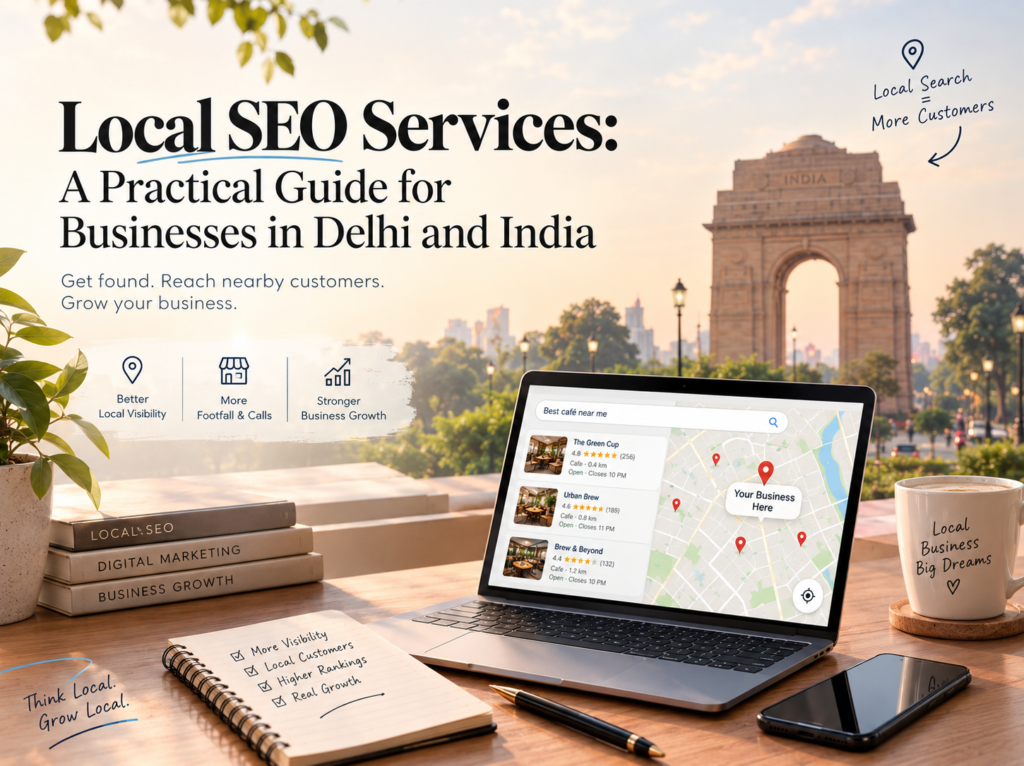
A potential customer searches for a dentist near them, a digital marketing agency in Delhi, or a plumber in their neighbourhood. Several businesses appear in the results. The customer checks a few listings, compares reviews and websites, and contacts the business that seems most suitable.
Will your business appear when that search happens?
Local SEO helps your business become more visible to people searching for relevant products or services in a specific area. It combines website optimization, Google Business Profile management, local business information, reviews, and other activities that help customers discover and evaluate your business online.
For small businesses, service providers, shops and professional firms, local SEO can be a practical way to attract more relevant enquiries. However, results depend on your market, competition, business location, and the quality of your website and online presence.
This guide explains how local SEO works, which services matter most, what mistakes to avoid, and how businesses in Delhi and across India can build a stronger local presence.
What Is Local SEO?
Local SEO, or local search engine optimization, is the process of improving a business’s visibility in search results for location-related queries.
For example, someone might search for:
- Best dentist in Rohini
- Digital marketing agency in Delhi
- AC repair service near me
- Italian restaurant in Connaught Place
- Website design company in Noida
These searches suggest that the person wants a relevant business in a particular area. Local SEO helps search engines understand your services, business information and geographic relevance.
Local search visibility can include Google Maps results, local business listings, and regular organic search results.
The main goal is to connect your business with people who are already looking for what you offer. It does not guarantee first-page rankings, but a well-maintained local presence can make your business easier to discover.
Why Do Local SEO Services Matter for Businesses?
Many customers research a business online before visiting a shop, booking an appointment or requesting a quotation. If your competitors appear in relevant searches while your business remains difficult to find, you may miss potential customers.
Local SEO helps address this problem in several ways.
1. Improve visibility in local searches
A properly optimized website and Google Business Profile give search engines clearer information about your business.
For instance, a salon in Lajpat Nagar may want to reach people searching for salon services in that area. Relevant service pages, accurate business details and a complete profile can help search engines understand the business.
Rankings are not guaranteed, but these improvements provide a stronger foundation.
2. Attract more relevant visitors
Not every website visitor is a potential customer. Someone searching for a service in Delhi may have little interest in a business that only serves customers in Mumbai.
Local SEO helps you focus on searches that match your location and services. This can bring more relevant visitors to your website and business listing.
3. Build trust before the first conversation
Customers often compare business details, photographs, reviews and service information before making contact.
Accurate opening hours, genuine reviews and a useful website make that decision easier. In contrast, outdated phone numbers or conflicting addresses can create doubt.
4. Support calls, visits and enquiries
Depending on your business, customers may contact you by phone, request directions, submit a form or visit your website.
Local SEO helps improve the online information that supports these actions. Track calls and enquiries to understand whether your work is generating useful business opportunities.
5. Build a stronger long-term online presence
Paid advertising can generate visibility while a campaign is running. SEO takes a different approach by improving your website and online presence over time.
Local SEO still requires ongoing attention. Competitors change their strategies, business details become outdated and customer expectations evolve. Regular maintenance helps keep your online information useful.
What Do Local SEO Services Include?
Local SEO is more than adding a city name to your homepage. A practical strategy covers several connected areas.
1. Google Business Profile optimization
Google Business Profile helps eligible businesses manage how they appear on Google Search and Maps.
An optimized profile should accurately represent the real business. Depending on your business type, important details include:
- Correct business name
- Appropriate primary and additional categories
- Accurate address or service area
- Current opening hours
- Working phone number
- Relevant website link
- Genuine business photographs
- Clear descriptions of products and services
Choose categories that reflect what your business actually does. Do not add keywords to the business name unless they form part of its genuine, real-world name.
Businesses that serve customers at their locations may need different settings from businesses with a customer-facing storefront. Follow Google’s eligibility and representation guidelines before creating or changing a profile.
2. Local keyword research
Keyword research helps identify the terms potential customers use when looking for your services.
A local SEO strategy should consider both the service and the location. For example, a business providing SEO services might investigate searches such as:
- Local SEO services in Delhi
- SEO agency in Delhi
- Local SEO company near me
- Google Business Profile optimization services
- SEO services for small businesses
These phrases are starting points, not proof of search volume. Use keyword research tools and Google Search Console data where available to evaluate demand and performance.
Do not create a separate page for every slight variation of the same keyword. Build pages around distinct services, locations and customer needs.
3. Website optimization for local search
Your website should explain what you offer, who you serve and how customers can contact you.
Important on-page SEO elements include:
- A descriptive SEO title and meta description
- One clear main heading
- Useful service descriptions
- Relevant location information
- Descriptive page URLs
- Internal links between related pages
- Mobile-friendly navigation
- Fast, reliable page performance
- Clear contact details and calls to action
For example, a web design agency serving Delhi could have a dedicated service page explaining its website design services, project process and service area.
The page should answer real customer questions. Repeating “web design company in Delhi” in every paragraph will not make it more useful.
4. Local landing pages
A local landing page explains a service in the context of a specific area.
Suppose your company serves customers in Delhi and Noida. Separate pages may be useful if the services, customer needs or practical details differ by location.
A good location page can include:
- Services available in that area
- Relevant local business information
- The areas you genuinely serve
- Examples of common customer requirements
- Frequently asked questions
- A clear way to request a quote
Avoid publishing dozens of near-identical pages with only the city name changed. Thin or repetitive pages provide little value to customers.
Create a location page only when you can make it genuinely useful.
5. Local citations and business listings
A local citation is an online mention of your business information, such as its name, address and phone number.
Relevant directories, professional associations and industry websites may help customers discover your business. Accurate listings also reduce confusion when people compare information across different platforms.
Start with your most important profiles. Check that the business name, contact details, address and website are correct.
You do not need to submit your business to every directory you can find. Prioritize legitimate, relevant platforms over large numbers of low-quality listings.
6. Review management
Customer reviews influence how people evaluate a business. They can also contribute to a stronger overall local presence.
Ask genuine customers to share honest feedback after a real transaction or service experience. Make the process straightforward, and respond professionally to both positive and negative reviews.
When replying to a complaint, acknowledge the concern and offer a practical next step. Avoid sharing private customer information in public responses.
Never buy reviews, create fake accounts or offer rewards in exchange for positive ratings. These practices can damage trust and violate platform policies.
7. Local content creation
Useful local content answers questions that customers in your service area actually have.
For example, a Delhi-based digital marketing agency could publish guides about local search optimization for clinics, restaurants, retailers or professional service firms.
A home maintenance company might explain seasonal maintenance needs or describe the services it offers in its genuine service area.
Good local content should provide information beyond the location name. Explain the problem, give practical advice and help readers decide what to do next.
8. Technical SEO and mobile usability
Local SEO also depends on whether search engines can access and understand your website.
Check for broken pages, incorrect redirects, duplicate URLs, indexing problems and confusing site navigation. Make sure important service information is available on mobile devices.
Many customers use phones to compare businesses while travelling or making plans. Contact buttons, forms and directions should be easy to use on a small screen.
Technical improvements will not automatically produce higher rankings, but they can remove obstacles that affect search visibility and the customer experience.
How Does Google Decide Which Local Businesses to Show?
Google explains that local results are mainly based on three factors: relevance, distance, and prominence.
Relevance
Relevance describes how well a business matches the search.
If someone searches for a physiotherapy clinic, a complete and accurate profile describing a different service may not be a good match. Choose appropriate categories and provide clear information about your actual services.
Distance
Distance refers to how far a business is from the location used in the search. That location may be the searcher’s current position or another location specified in the query.
A business cannot simply overcome distance by adding more city names to its website. Location and the searcher’s needs remain important.
Prominence
Prominence relates to how well-known a business is. Google can use information such as links, reviews, and other signals when assessing prominence.
You can work on your website quality, reputation and genuine business presence. However, no SEO agency can guarantee a particular position for every searcher.
This is why a local SEO plan should focus on sustainable improvements rather than promises of instant rankings.
Local SEO vs. Traditional SEO
Both approaches aim to improve organic visibility, but their emphasis can differ.
| Area | Local SEO | Traditional SEO |
|---|---|---|
| Main focus | Relevant searches with local intent | Relevant searches across broader markets |
| Common search | Dentist in Delhi | How to choose a dentist |
| Key activities | Business profile, local pages, reviews and citations | Content, technical SEO, site structure and backlinks |
| Typical audience | Customers in a service area | Users who may be located anywhere |
| Useful measurements | Calls, direction requests, local visibility and enquiries | Organic traffic, rankings and conversions |
The two approaches overlap. A business targeting local customers still needs a useful website, strong technical foundations and relevant content.
How to Improve Local SEO: A Step-by-Step Plan
You do not need to change everything at once. Start with the tasks that correct the biggest problems.
Step 1: Audit your current online presence
Search for your business name and important services. Review your website, Google Business Profile and key business listings.
Look for missing information, outdated contact details, duplicate profiles and pages that do not explain your services clearly.
Step 2: Fix your Google Business Profile
Confirm that you are eligible for a profile and that the information reflects your real business.
Select accurate categories, update opening hours and add relevant photographs. If customers visit your premises, make sure the address and directions are correct.
If you operate as a service-area business, configure the profile according to Google’s rules for that business type.
Step 3: Research your local keywords
List your main services and the locations you genuinely serve.
Use keyword research tools, search suggestions and existing website data to identify relevant topics. Review the results to understand what customers expect to find.
Choose a primary topic for each important page. This makes it easier to create focused content without unnecessary keyword repetition.
Step 4: Improve your service pages
Explain the service, the problems it solves and what customers can expect.
Add clear headings, useful examples and a relevant call to action. Include location information when it helps the reader understand your service coverage.
Step 5: Strengthen your reputation
Make it easy for genuine customers to leave feedback. Respond to reviews consistently and use recurring questions or concerns to improve your service.
A thoughtful response to a negative review can demonstrate professionalism. It does not need to become an argument.
Step 6: Build relevant local references
Check established directories, trade associations and other relevant websites. Correct existing information before creating more listings.
Look for legitimate opportunities to contribute useful content or earn links from relevant organizations.
Step 7: Measure performance and improve
Use Google Search Console to monitor organic search performance. Review Google Business Profile performance data when available, along with your website analytics and enquiry records.
Measure changes in relevant impressions, clicks, calls and qualified leads. Compare similar periods where possible, and account for seasonal demand.
Do not judge a local SEO campaign by one keyword alone.
Local SEO Services in Delhi: What Should You Consider?
Delhi has businesses across many industries, from neighbourhood shops and clinics to agencies, restaurants and professional firms. Their local SEO needs can be very different.
A restaurant may need accurate opening hours, menus, photographs and location information. A consultant may need strong service pages, clear contact details and relevant professional references.
A business serving customers across several areas may need a carefully planned set of location pages. A shop serving one neighbourhood may benefit more from improving its existing profile and website.
Before investing in local SEO services in Delhi, ask a provider to explain:
- What your current online presence is missing
- Which services and locations should be prioritized
- How the strategy will address your competition
- Which work is included in the monthly fee
- How progress and leads will be measured
- What the business needs to provide
- How often you will receive reports
Avoid agencies that promise guaranteed rankings or refuse to explain their methods. SEO requires testing, consistent work and realistic expectations.
Need help identifying gaps in your local search presence? Digizebra can be considered for a discussion about your SEO requirements, website and business goals. Review the proposed scope carefully and choose services that match your needs.
How Much Do Local SEO Services Cost?
There is no single price that suits every business. Costs depend on the scope of work, competition, number of locations, website condition and the resources needed to implement the strategy.
A small business with one location may need profile optimization and improvements to a few service pages. A company serving multiple locations may require more research, content, technical work and ongoing reporting.
Before comparing quotes, ask for a clear breakdown of:
- Initial audit and strategy
- Google Business Profile work
- On-page and technical SEO
- Content creation
- Citation cleanup and local link building
- Reporting and performance reviews
Compare the work included, not just the monthly price. A cheaper package may exclude important tasks, while a larger package may include services your business does not need.
Request a written scope of work and confirm how success will be measured before starting.
Common Local SEO Mistakes to Avoid
Several mistakes can waste time or undermine your online presence.
Keyword stuffing
Repeating the same location and service phrase in every heading makes content awkward. Write naturally and use variations when they genuinely fit.
Creating fake business locations
Do not use virtual offices or fabricated addresses to appear closer to customers. Business information must follow Google’s eligibility and representation guidelines.
Buying reviews
Fake reviews can mislead customers and violate platform rules. Build your reputation through genuine customer experiences.
Publishing duplicate location pages
Changing only the city name does not create useful local content. Each page should have a clear purpose and provide meaningful information.
Ignoring mobile visitors
A page that is difficult to read or a contact form that fails on a phone can lose potential enquiries. Test important pages on mobile devices.
Expecting instant results
Search visibility can change gradually, and results vary by competition and starting conditions. Review performance over time rather than expecting immediate rankings.
Measuring rankings without measuring leads
Rankings are useful, but they do not tell the whole story. Track relevant calls, enquiries and conversions to see whether your visibility is helping the business.
How to Choose the Right Local SEO Agency
Choosing a provider is easier when you know what good work looks like.
Start by asking for an audit or an explanation of the problems they have identified. The agency should be able to connect its recommendations to your services, locations and business goals.
Look for a provider that:
- Explains the strategy in plain language
- Uses accurate business information
- Focuses on relevant searches and customers
- Follows search engine and platform guidelines
- Provides clear reporting
- Sets realistic expectations
- Explains what it can and cannot control
Ask how the agency plans to measure progress. A useful report should explain completed work, changes in visibility and the quality of enquiries where that data is available.
You should also retain access to your website, business profile and analytics accounts. Clear ownership and communication make the relationship easier to manage.
Frequently Asked Questions About Local SEO
1. What are local SEO services?
Local SEO services help businesses improve visibility in location-related searches. They may include Google Business Profile optimization, keyword research, website improvements, local content, citation management and review support.
2. Is local SEO useful for small businesses?
Yes. It can help small businesses become easier to discover when people search for relevant products or services nearby. Results depend on demand, competition, location and the quality of the business’s online presence.
3. How long does local SEO take to work?
There is no fixed timeline. Some changes may be reflected relatively quickly, while meaningful improvements can take weeks or months. Competition, website condition, and the work completed all influence the outcome.
4. Can a business rank on Google Maps without a website?
An eligible business can have a Google Business Profile without owning a website. However, a useful website can provide additional information about its services and give customers another way to contact the business.
5. What is the difference between local SEO and Google Business Profile optimization?
Google Business Profile optimization focuses on a business’s listing on Google. Local SEO is broader and can include the website, location pages, local citations, reviews, technical SEO, and relevant links.
6. Do local SEO services in Delhi work for businesses in other cities?
Yes. Local SEO principles can apply to businesses in Delhi, Noida, Gurgaon, Mumbai, Bengaluru, and other locations. The strategy should reflect the actual areas served and the needs of customers in each market.
7. How much should a business spend on local SEO?
The budget depends on competition, location count, website condition, and the work required. Ask for a clear proposal that explains deliverables, reporting and expected priorities instead of choosing a package based only on price.
8. Can an SEO agency guarantee the number-one local ranking?
No responsible agency can guarantee a specific ranking. Search results depend on several factors, including relevance, distance, and prominence. A trustworthy provider focuses on sound practices, measurable progress, and qualified business enquiries.
Conclusion: Build a Local Presence That Customers Can Trust
Local SEO isn’t just about adding a city name to your website. It means keeping your business information accurate, improving relevant pages, building trust, and helping customers understand why your service fits their needs.
Start with the basics. Check your Google Business Profile, correct outdated listings, and improve the pages that describe your services. Then measure what changes and use the findings to guide your next steps.
For businesses looking for local SEO services in Delhi, the best starting point is a strategy based on actual business goals rather than ranking promises.
Want to improve your business’s local search visibility? Visit Digizebra to explore its digital marketing services and discuss your SEO requirements. A clear audit and practical plan can help you decide which improvements deserve attention first.